
DANIEL ROSEBERRY
Interview by Filep Motwary
Through a journey steeped in emotion, instinct, and radical self-invention, Daniel Roseberry has emerged as one of the most compelling voices shaping modern fashion. From the sun-bleached plains of Texas to the gilded salons of Paris, the designer undertook the audacious revival of Schiaparelli—a maison weighted with surrealist mythology and historic gravitas.
In less than two years, Roseberry had already etched his signature into the cultural zeitgeist. In January 2021, his work became inseparable from a moment that felt both cinematic and seismic: the inauguration of Joe Biden. Draped in Schiaparelli, Lady Gaga delivered the national anthem, a gilded dove of peace pinned close to her heart. It was not merely a fashion moment—it was a rewriting of the visual language of power in real time.
“I’m moved that you ask about that day,” Roseberry says quietly. “The world’s response was immediate, emotional. I had to pause—to understand what it meant, not just for my work, but for my family, my country. It felt like crossing a threshold.”
The now-iconic gown came to life in just eight days—crimson silk dyed in Paris, anchored by a sculptural cashmere bodice. “It was instinct, and faith in my team,” he reflects. “The atelier is the invisible force behind everything. That sense of urgency, of trust—I want to protect that. There’s no space for cynicism in what I do.”
At 33, each Schiaparelli collection under Roseberry’s direction challenges conventions of gender, identity, and form. “I’m queer, I’m gay,” he says with candor. “And some mornings I wake up asking—do I feel more masculine, or more feminine? Not as a role, but as a sensation. That’s where creativity begins.”
Raised in Plano, Texas, far from fashion’s epicenters, his early life was shaped by faith and duality. The son and brother of preachers, Roseberry grew up immersed in the rituals of the Episcopal Church, while his mother—a calligrapher from a lineage of painters—offered a counterpoint of artistic sensitivity. “I was always between two worlds,” he recalls.
Summers in New York, visiting his grandmother on Long Island, offered a glimpse into another life—one of beauty and possibility. “We didn’t have money,” he admits. “But my father’s faith opened doors. A scholarship changed everything. That was the beginning.”
Today, Roseberry stands as the only American couturier leading a major Parisian house. “I still feel like an outsider,” he says. “Like Elsa Schiaparelli herself is guiding me. She was always the rebel, the stranger.”
A recent moment that moved him? A woman recreating Gaga’s inauguration look entirely in crochet. “Fashion belongs to everyone,” he says. “It can be born anywhere.”
His formative years included a decade at Thom Browne, where discipline and precision defined his daily rhythm. “Since childhood, I wore uniforms—church, school, then Thom Browne’s flannel suit. When I left, I didn’t know who I was anymore. That uncertainty became part of my evolution.”
His debut for Schiaparelli in 2019 marked a personal and creative rupture. He recalls critic Tim Blanks describing it as “not perfect, but brave.” For Roseberry, that word—bravery—remains a guiding force.
Reflecting on fashion’s shifting landscape, he speaks of loss. The death of Alexander McQueen and the fall of John Galliano, he notes, marked the end of an era. “We lost grandeur. We lost the dream.”
When the call from Schiaparelli came, he was in his Chinatown studio in Manhattan. “That moment became the seed of my first collection,” he says. “Not looking backward, but imagining what the house could be now.”
Under his direction, Schiaparelli has re-emerged with startling clarity—its surrealist DNA reinterpreted through meticulous craftsmanship and bold, otherworldly ornamentation. “I needed the freedom to discover the house’s language myself,” he explains. “Not to replicate the past, but to evolve it.”
Owned by Diego Della Valle, the house operates, as Roseberry describes, as “fashion’s final dream.” And he is determined to keep it alive. “We are the jewel of a billion-dollar industry. Now more than ever, we must protect its values while moving forward.”
The legacy of Elsa Schiaparelli looms large—her collaborations with Salvador Dalí, Jean Cocteau, and Man Ray redefining the boundaries between fashion and art. Her fascination with the body—its distortions, its symbolism—remains central to Roseberry’s vision.
“Surrealism isn’t static,” he says. “It’s a state of mind. The body is constant, but how we interpret it evolves. That’s where the power lies.”
For Roseberry, this philosophy is deeply personal. “Until I was 20, I struggled with my body,” he admits. “But something shifted when I turned 30. I found peace. My body became my ally. That changed everything—personally and creatively.”
His latest Haute Couture collection reflects that transformation: graphic, unapologetic, designed for women of presence and power, including figures like Kamala Harris. “It was created for the digital world,” he notes. “I wanted it to live as strongly on screen as it does in reality.”
When asked what defines a great designer, his answer is disarmingly simple: “Knowing when to ask for help.”
And on Couture versus prêt-à-porter, he offers a final reflection. “With Couture, there’s no last-minute change. You have to trust—yourself, your team, the process. When I arrived, I realized my role ends at the atelier door. I’m still learning. I’m still becoming.”
In the city of light, an American outsider continues to shape a house built on dreams—proving that fashion, at its most powerful, is not about perfection, but about belief.
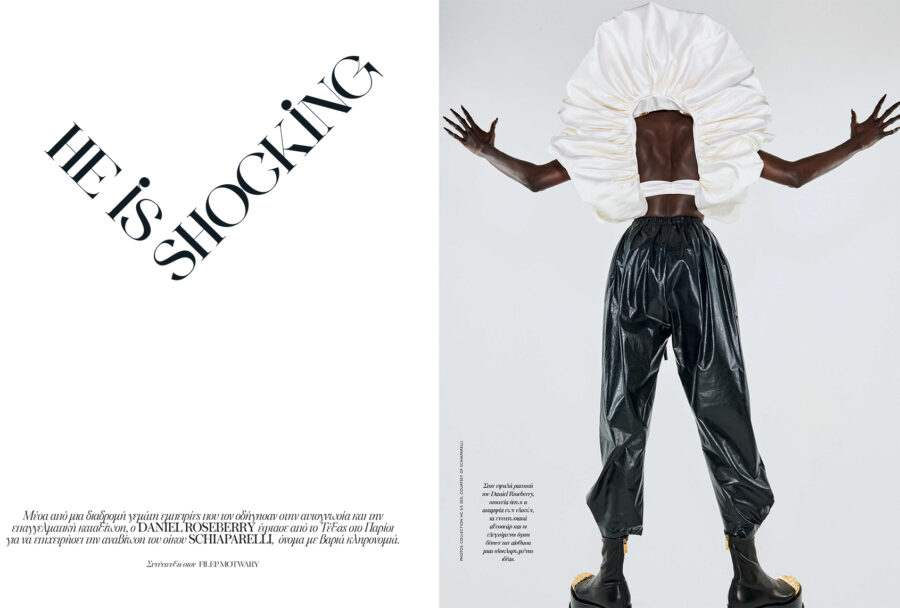
This is the opening spread from Schiaparelli’s creative director’s interview of Daniel Roseberry by Filep Motwary, as it was published in Vogue Greece, issue May 2021.
The interview was published in Vogue Greece, in May 2021.
- SHARE


Texas-born Daniel Roseberry took over as artistic director at Schiaparelli following Bertrand Guyon’s departure in April 2019, having previously spent 11 years at ready-to-wear brand Thom Browne . His debut collection had “an audacity that had a perfect, refreshing logic,” said BoF Editor-at-Large Tim Blanks in his review.
Roseberry studied at Fashion Institute of Technology in New York before starting his career at Thom Browne in 2008. Over the last five years, Roseberry acted as the brand’s design director of men’s and women’s collections.
In April 2019, Schiaparelli announced the departure of Bertrand Guyon, who held the role of design director for four years. A week later, Daniel Roseberry was announced as Guyon’s successor, to take charge of all collections and projects at the storied Place Vendôme house. The designer debuted his first collection for the house for the Autumn/Winter 2019 couture season, despite never working in a couture atelier before. Notably, he also does not speak French but instead, another member of the atelier translates his instructions.
Photo by Estelle Hanania. Styled by Patti Wilson for The New York Times
